





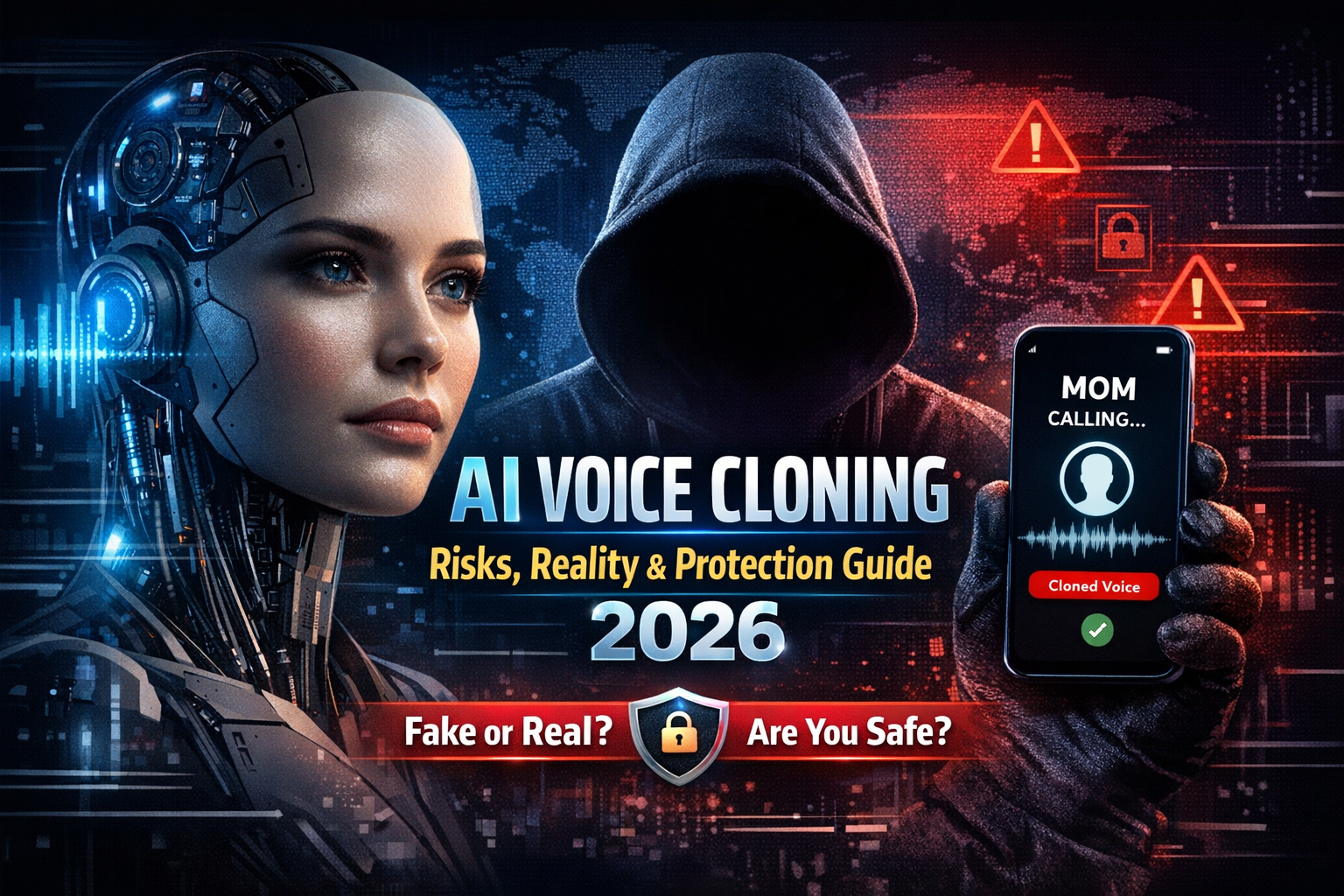
Artificial Intelligence is evolving faster than ever before. From smart assistants to automated customer service, AI is transforming the way we live and work. But with every powerful innovation comes a potential risk. One of the most concerning developments in recent years is AI Voice Cloning.
Imagine receiving a phone call from someone who sounds exactly like your parent, your child, or your CEO — asking for urgent help or money. The voice is familiar. The tone is real. The emotion feels authentic. But it’s completely fake. For more in-depth guides on AI trends, digital safety, and emerging technology updates, visit our official website at https://kainattrendscapes.com/ where we regularly publish research-based content.
This is not science fiction. This is the reality of AI Voice Cloning in 2026.
In this complete guide, you will learn:
- What AI Voice Cloning is
- How it works
- Real-world risks and scams
- How to detect fake voices
- And most importantly, how to protect yourself
What Is AI Voice Cloning?
AI Voice Cloning is a technology that uses artificial intelligence and deep learning algorithms to replicate a person’s voice. With just a short audio sample — sometimes even 10 to 30 seconds — AI systems can analyze tone, pitch, accent, speaking rhythm, and emotional patterns to generate a nearly identical synthetic voice.
Once trained, the system can convert any written text into speech that sounds like the original person.
This technology is powered by:
- Machine learning
- Neural networks
- Text-to-speech (TTS) systems
- Voice synthesis models
While AI Voice Cloning has legitimate uses in entertainment, accessibility, and business automation, it also presents serious security and ethical concerns.
How AI Voice Cloning Works
To understand the risks, we first need to understand how the technology functions.
1. Voice Data Collection
The AI system collects voice samples from:
- Social media videos
- Podcasts
- Interviews
- YouTube content
- Voice notes
The clearer and longer the audio sample, the more accurate the clone.
2. Pattern Analysis
Advanced neural networks analyze:
- Frequency
- Tone
- Accent
- Speech speed
- Emotional expression
- Breathing and pauses
The AI essentially “learns” how the person speaks.
3. Voice Generation
Once trained, the AI can generate new speech in that voice by simply typing text into the system. Some tools even allow real-time voice conversion during live calls.
This level of realism is what makes AI Voice Cloning both impressive and dangerous.
Why AI Voice Cloning Is Growing Rapidly in 2026
In previous years, voice cloning technology required expensive equipment and large datasets. Today, cloud-based AI tools have made it accessible to almost anyone.
Reasons for its growth include:
- Affordable AI platforms
- Increased digital content creation
- Remote communication growth
- High demand for personalized voice automation
- Rise of generative AI tools
Unfortunately, accessibility also means higher misuse potential.
The Real Dangers of AI Voice Cloning
Now let’s discuss the most serious risks.
1. Financial Scams
One of the most common uses of AI Voice Cloning is emotional fraud.
Scammers clone a family member’s voice and call parents claiming:
“I’ve been in an accident.”
“I’m in trouble. Please send money urgently.”
Because the voice sounds real, victims panic and transfer money immediately.
These scams have already caused thousands of dollars in losses globally.
2. Corporate Fraud
Businesses are increasingly becoming targets.
Fraudsters clone a CEO’s voice and call the finance department requesting urgent wire transfers. Employees often comply because the voice sounds authentic.
Several companies worldwide have lost millions through this method.
3. Political Manipulation
Fake audio clips of politicians can be generated and spread online, causing misinformation, panic, or reputational damage.
In election years, this becomes especially dangerous.
4. Reputation Damage
Celebrities, influencers, and public figures are vulnerable. A fake audio recording can destroy trust overnight.
Once misinformation spreads online, it becomes extremely difficult to control.
Real-Life Examples of AI Voice Cloning Abuse
While we won’t mention specific names, global reports confirm:
- Parents being scammed through cloned child voices
- Executives tricked into transferring company funds
- Fake political audio clips spreading on social media
These cases prove that AI Voice Cloning is not just theoretical — it is already happening.
How to Detect AI Voice Cloning
Although AI voices are becoming more realistic, there are still warning signs.
1. Slight Robotic Tone
Even advanced systems may have subtle mechanical undertones.
2. Emotional Inconsistency
Sometimes the emotion does not fully match the context.
3. Urgency and Pressure
Scammers often create extreme urgency to prevent verification.
4. Background Noise Patterns
AI-generated voices may lack natural environmental sounds.
5. Verification Test
Ask a personal question only the real person would know.
How to Protect Yourself from AI Voice Cloning Scams
Protection is possible with smart strategies.
1. Create a Family Code Word
Establish a secret word for emergencies. If someone calls in distress, ask for the code word.
2. Never Act on Voice Alone
Always confirm financial requests through:
- Video calls
- Direct callback
- Official company channels
3. Strengthen Corporate Policies
Businesses should require:
- Multi-level approval systems
- Written confirmation
- Two-factor authentication
4. Limit Public Voice Exposure
Avoid posting excessive high-quality voice recordings online.
5. Stay Educated
The more you understand AI Voice Cloning, the harder it becomes for scammers to exploit you.
Legal and Ethical Considerations
The legality of AI Voice Cloning depends on its usage.
Legal Uses:
- Audiobook narration
- Film dubbing
- Accessibility tools
- Voice restoration for patients
Illegal Uses:
- Fraud
- Identity theft
- Defamation
- Financial deception
Many governments are now drafting stricter AI regulations to prevent misuse.
The Positive Side of AI Voice Cloning
Despite the risks, the technology also offers powerful benefits.
- People who lost their voice due to illness can regain a digital version of it
- Content creators can scale audio production
- Businesses can automate customer service
- Game developers can create dynamic characters
Like all tools, AI Voice Cloning depends on how it is used.
The Future of AI Voice Cloning
Experts predict that in the coming years:
- AI watermarking systems will identify synthetic voices
- Advanced detection software will improve
- Regulations will become stricter
- Voice authentication systems will evolve
The future may involve AI fighting AI — detection systems versus cloning systems.
Why Awareness Matters More Than Fear
Technology is not the enemy. Lack of awareness is.
AI Voice Cloning is powerful, but when you understand the risks and follow smart verification steps, the threat significantly decreases.
Digital safety in 2026 is no longer just about passwords. It is about protecting your voice identity as well.
Final Thoughts
AI Voice Cloning represents both innovation and risk. It is one of the most powerful AI developments of our time. While it enables creativity, accessibility, and automation, it also opens new doors for scams, fraud, and digital manipulation.
The key is not fear — it is awareness.
As AI continues to evolve in 2026, governments and cybersecurity experts are working to strengthen detection systems and create safer digital environments. You can explore official guidance and digital safety resources from trusted organizations like the National Institute of Standards and Technology (NIST) here:
https://www.nist.gov/artificial-intelligence
Staying informed, verifying unusual requests, and using multi-step authentication can dramatically reduce your risk.
In today’s digital world, protecting your voice identity is just as important as protecting your password. Technology will continue to advance — and we must advance with it.