




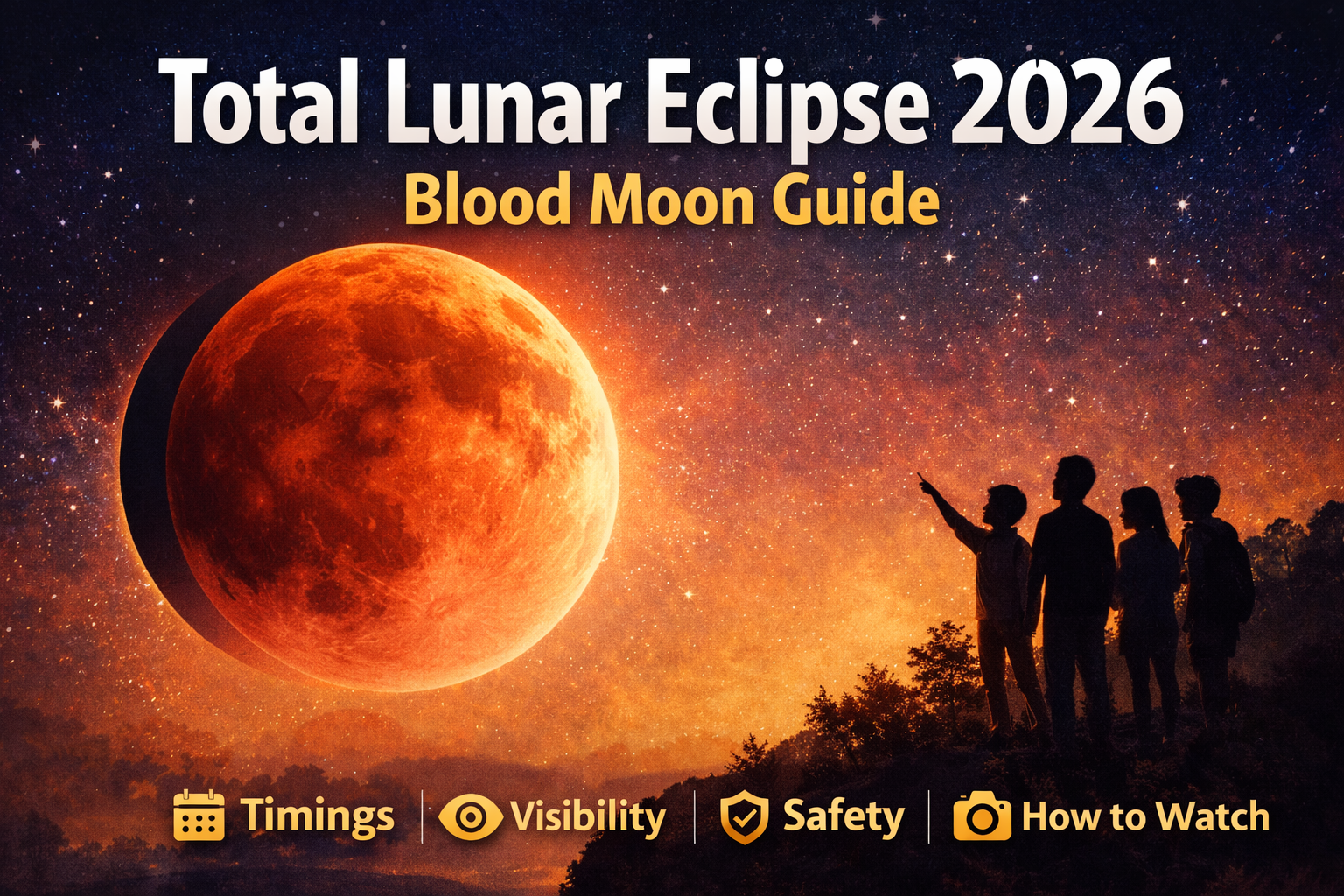
Total Lunar Eclipse 2026 has captured global attention as sky watchers, scientists, photographers, and curious observers look up to witness one of nature’s most breathtaking events — the Blood Moon. A lunar eclipse is not just a beautiful astronomical moment; it is a powerful reminder of how perfectly our solar system moves in harmony.
Unlike a solar eclipse, a lunar eclipse is completely safe to watch with the naked eye. There is no need for special glasses or protective equipment. This makes it one of the most accessible celestial events for families, students, and amateur astronomers.
In this detailed guide, you will learn what causes a total lunar eclipse, why the Moon turns red, when and where it is visible, its cultural meaning, scientific importance, photography tips, and fascinating facts that most people don’t know.
For more updates, guides, and the latest articles on science, technology, and lifestyle, visit KainatTrendScapes.com.
What Is a Total Lunar Eclipse 2026?
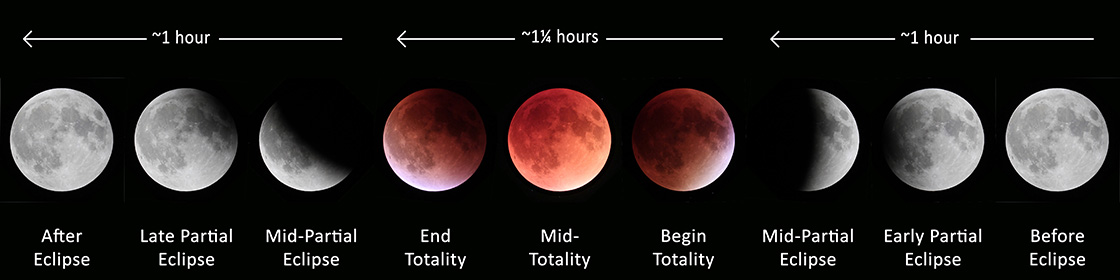
4:A total lunar eclipse happens when the Earth moves directly between the Sun and the Moon. During this alignment, Earth blocks sunlight from reaching the Moon, casting a shadow on it.
There are three types of lunar eclipses:
- Penumbral Lunar Eclipse – The Moon passes through Earth’s outer shadow, causing slight dimming.
- Partial Lunar Eclipse – Only part of the Moon enters Earth’s darker shadow.
- Total Lunar Eclipse – The entire Moon moves into Earth’s umbra (darkest shadow), turning red.
The total lunar eclipse is the most dramatic and visually stunning type.
Why Is It Called a Blood Moon?
During a total lunar eclipse, the Moon doesn’t disappear completely. Instead, it turns a deep red or copper color. This is why it is often called a Blood Moon.

The red color happens because Earth’s atmosphere scatters sunlight. Shorter blue wavelengths are scattered away, while longer red wavelengths bend around Earth and reach the Moon.
This same effect is what makes sunsets appear red. During a lunar eclipse, the Moon is essentially illuminated by all the sunrises and sunsets happening around Earth at that moment.
According to NASA, the intensity of the red color depends on atmospheric conditions. Dust, pollution, and volcanic particles in the air can make the Moon appear darker or brighter red.
When Does the 2026 Total Lunar Eclipse Occur?
The Total Lunar Eclipse of March 2026 occurs during a full moon phase. Exact timing varies depending on your location, but the main stages include:
- Penumbral phase begins
- Partial eclipse begins
- Totality begins (Moon turns fully red)
- Maximum eclipse
- Totality ends
- Partial phase ends
The total phase usually lasts around 1 to 1.5 hours, while the entire event can last several hours.
Because the eclipse happens at night, it is visible from large parts of the world depending on geographic position.
Where Will the Eclipse Be Visible?
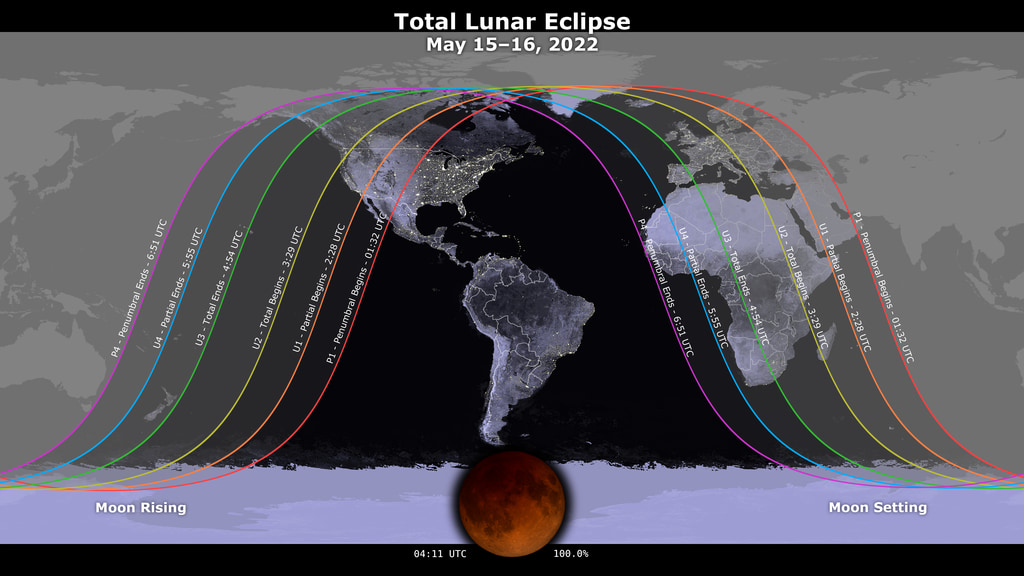
4
A total lunar eclipse is visible from anywhere on the night side of Earth. Unlike a solar eclipse, which is visible only in a narrow path, lunar eclipses can be seen across entire continents.
Regions that may witness the 2026 eclipse include:
- Parts of Asia
- Europe
- Africa
- Australia
- Portions of the Americas
Visibility depends on local moonrise and moonset times. If the Moon is above the horizon during totality in your region, you will be able to see the red Moon clearly.
Scientific Importance of Lunar Eclipses
Lunar eclipses are not just beautiful — they are scientifically valuable.
Astronomers study eclipses to:
- Understand Earth’s atmosphere
- Measure atmospheric dust levels
- Observe lunar surface temperature changes
- Study Earth’s shadow geometry
The International Astronomical Union recognizes eclipses as important opportunities for both professional and amateur research.
Lunar eclipses also help scientists refine orbital calculations and understand long-term Earth-Moon dynamics.
Cultural and Historical Significance
Throughout history, lunar eclipses have been surrounded by myths and beliefs.
In many ancient civilizations, a red Moon was seen as a sign of:
- Major change
- Warning
- Transformation
- Spiritual awakening
Some cultures believed a dragon or animal was swallowing the Moon. Others viewed it as a battle between light and darkness.
In modern times, science has replaced superstition, but the emotional impact of seeing a Blood Moon remains powerful.
Is a Lunar Eclipse Dangerous?
No. A lunar eclipse is completely safe to observe.
Unlike a solar eclipse, there is:
- No harmful radiation
- No eye damage risk
- No need for protective glasses
You can watch it directly with your eyes, binoculars, or a telescope.
How to Watch the Lunar Eclipse Properly
Watching a lunar eclipse is simple, but preparation improves the experience.
1. Find a Dark Location
Move away from city lights if possible. Dark skies enhance visibility.
2. Check Local Timing
Know exactly when totality begins in your area.
3. Bring Binoculars or Telescope
While not required, they enhance details on the lunar surface.
4. Dress Comfortably
Eclipses can last several hours, so prepare accordingly.
Photography Tips for Capturing the Blood Moon

4
Photographing a lunar eclipse requires patience.
Key tips:
- Use a tripod
- Use manual focus
- Keep ISO moderate
- Adjust shutter speed as brightness changes
- Use zoom lens for close shots
During totality, the Moon becomes dimmer, so longer exposures may be needed.
How Often Do Total Lunar Eclipses Happen?
Total lunar eclipses do not occur every year in every location. On average, there are:
- 0 to 3 total lunar eclipses per year worldwide
However, visibility depends on where you live.
Because of Earth’s orbital mechanics, eclipse cycles repeat in patterns called Saros cycles, lasting approximately 18 years.
For global eclipse timing charts and visibility maps, the Time and Date provides accurate live tracking tools:
https://www.timeanddate.com/eclipse/
Difference Between Solar and Lunar Eclipse
Many people confuse the two events.
| Lunar Eclipse | Solar Eclipse |
|---|---|
| Earth between Sun and Moon | Moon between Sun and Earth |
| Happens at full moon | Happens at new moon |
| Safe to watch | Requires eye protection |
| Visible across wide area | Visible in narrow path |
Lunar eclipses are easier and safer for public viewing.
Psychological Impact of the Blood Moon
Even in modern times, celestial events influence human emotions.
Many people report feelings of:
- Wonder
- Reflection
- Calmness
- Inspiration
The rare sight of a red Moon often creates a sense of connection with nature and the universe.
Educational Value for Children
A total lunar eclipse is an excellent learning opportunity.
Children can learn about:
- Planetary motion
- Gravity
- Light and shadow
- Atmospheric science
Teachers and parents can use this event to explain scientific concepts in a real-world setting.
Common Myths About Lunar Eclipses
Myth 1: Lunar Eclipse Is Bad Luck
There is no scientific evidence supporting this belief.
Myth 2: Pregnant Women Should Stay Indoors
There is no medical basis for this claim.
Myth 3: Food Becomes Harmful
This is a cultural belief, not supported by science.
Lunar eclipses are natural astronomical events.
Why the 2026 Eclipse Is Special
Each eclipse has slightly different characteristics based on orbital alignment.
The 2026 event stands out because:
- It occurs during peak full moon visibility
- It aligns closely with seasonal celebrations in some regions
- It offers extended totality duration
Such factors increase public interest and media attention.
How to Explain the Eclipse Simply
Imagine Earth casting a giant shadow in space. When the Moon moves into that shadow, sunlight is blocked. But some red light bends around Earth and reaches the Moon, turning it red.
It is a beautiful demonstration of how light behaves in our atmosphere.
The Role of Modern Technology
Today, people can:
- Watch live streams
- Track real-time eclipse maps
- Use mobile apps for timing
- Capture high-resolution images
Technology has made astronomy more accessible than ever.
Environmental Awareness Connection
Lunar eclipses indirectly remind us about Earth’s atmosphere. The color and brightness of the Blood Moon depend on atmospheric clarity.
High pollution levels can affect eclipse appearance. This connection highlights the importance of protecting our planet.
Final Thoughts
The Total Lunar Eclipse of 2026 is more than just a celestial event. It is a moment that connects science, culture, history, and human curiosity.
Watching the Moon slowly turn red in the night sky creates a sense of awe that few natural events can match. It reminds us that we are part of a vast universe, moving in precise cosmic rhythm.
Whether you are an astronomy enthusiast, a student, a parent, or simply someone who enjoys nature’s beauty, this Blood Moon is worth experiencing.
Look up at the sky, take a moment to pause, and witness one of the universe’s most spectacular performances.
What is a total lunar eclipse?
A total lunar eclipse happens when the Earth moves between the Sun and the Moon, casting its shadow completely over the Moon and turning it red.
Why does the Moon turn red during a lunar eclipse?
The Moon appears red because Earth’s atmosphere bends and filters sunlight, allowing only red wavelengths to reach the Moon. This is the same reason sunsets look red.
Is it safe to watch a lunar eclipse with naked eyes?
Yes, a lunar eclipse is completely safe to watch without any protective glasses or equipment.
How long does a total lunar eclipse last?
The total red phase usually lasts about 1 to 1.5 hours, while the entire eclipse event can continue for several hours.
How often do total lunar eclipses occur?
There can be 0 to 3 total lunar eclipses per year globally, but visibility depends on your location.
Do lunar eclipses have any harmful effects on humans?
No, lunar eclipses are natural astronomical events and have no harmful effects on health.
Why is the 2026 lunar eclipse important?
It is significant due to its visibility in many regions and extended total phase, making it a major astronomical event of the year.